Were Flock Cameras a Civil Rights Violation, or Was It the Boyfriend Cops?
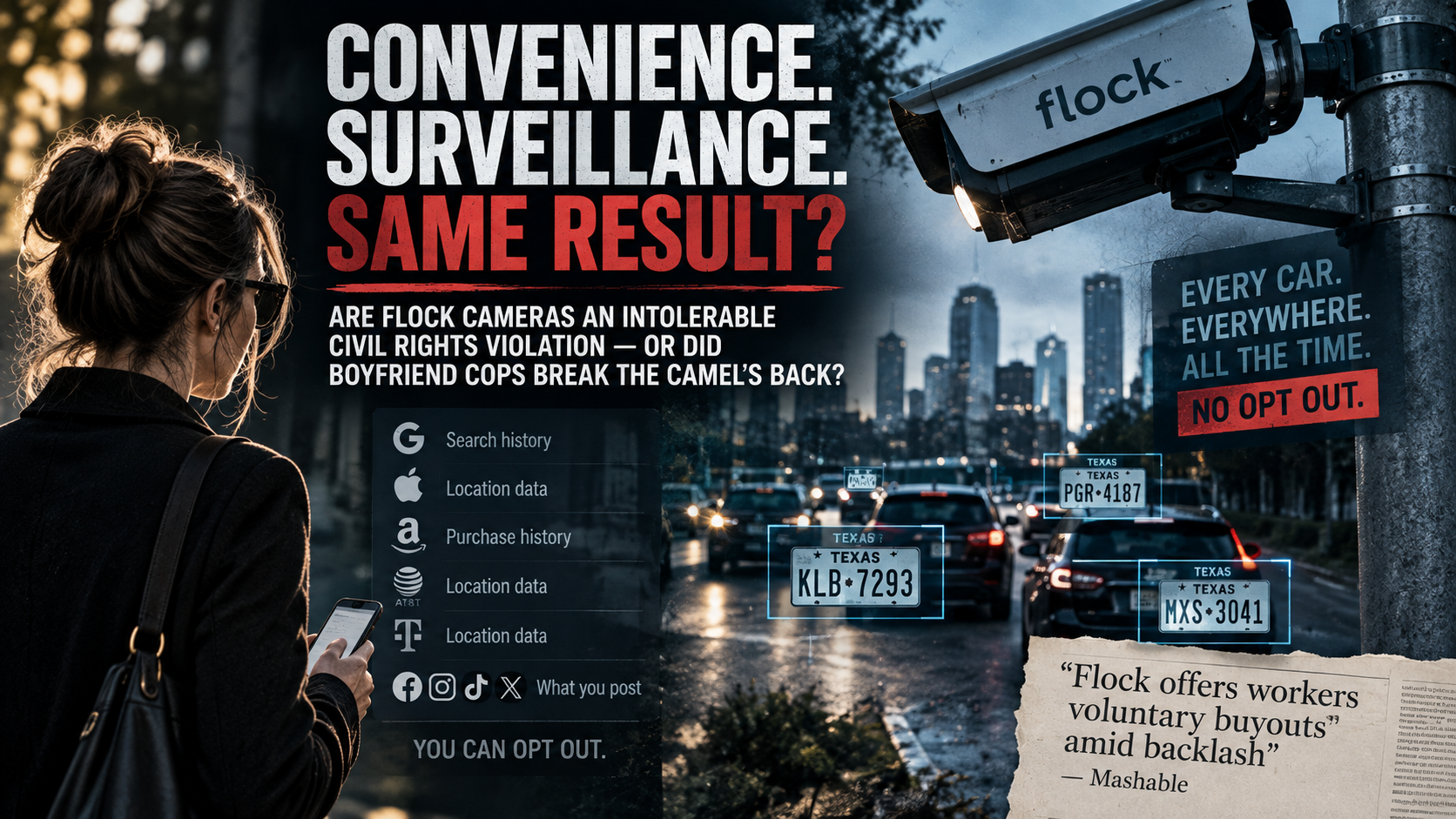
Flock Safety, the company that put automated license plate readers on utility poles in thousands of American towns, opened a voluntary buyout program for its employees last week as it loses customers and absorbs rising costs from camera vandalism. Florida and Texas announced they would stop using Flock’s technology, and an anti-surveillance group reported that 90 cities dropped Flock in August alone, a fourfold increase from July.
So here’s the question I keep turning over: were Flock cameras an inherently intolerable civil rights violation, or was it the widely publicized abuse by boyfriend cops that broke the camel’s back?
I think the honest answer is the second one, and I think that tells us something uncomfortable about what we actually care about.
We Are Already Tracked, and We’re Fine With It
We know that Google, Apple, Amazon, AT&T, T-Mobile, and a long list of data brokers sell our location history, our search history, and our purchase history to anyone who will pay the price. We know this. And yet we walk around all day with our phones powered on, no Faraday bag in sight, logged into everything.
We post more on social media, voluntarily, than any government agency could demand with the most aggressive warrant application presented to the most compliant judge in the state. Where we were, who we were with, what we bought, what we’re mad about, what our kids look like. All of it, free, timestamped, geotagged.
So why are we so bothered by one more form of tracking? Not one more layer, mind you. A license plate reader knows a lot less about you than your phone does. It’s just another form.
Local Law Enforcement Can’t Afford the Good Stuff
Here’s the irony. Law enforcement generally can’t afford the data these commercial vendors sell about us. So when police want to know where you’ve been, they have to do it the old-fashioned way: write a sworn affidavit, establish probable cause, and get a judge to sign a warrant before they can invade our “privacy.” There’s a process, there’s a paper trail, and there’s a neutral magistrate in the middle of it.
With Flock, the data are there for the asking. No affidavit, no judge, no probable cause. Just a login and a search box.
And, apparently, a handful of officers decided to use that search box to track people they had no legitimate reason to be looking for. The Washington Post identified 46 misuse cases in August, including allegations that police used Flock technology to stalk wives, girlfriends, or exes. That’s one reason many of us revolted.
The Red-Light Camera Reason
The other reason probably has to do with why Texans revolted against red-light cameras hard enough that the Legislature banned them. Nobody enjoyed being ticketed by a machine with no human judgment involved and no officer to talk to. It felt like a trap. It felt like the government had decided the easiest way to raise money was to build a system that catches ordinary people doing ordinary things.
License plate readers scratch the same nerve.
The Real Difference: You Can’t Opt Out
Here’s where I land. With all the commercial invasions of our privacy, we have essentially opted in. More importantly, we can opt out. We don’t have to search while signed in. We can use a VPN. We can stuff the phone in a Faraday bag. We can delete the social media apps. Most of us won’t, but we can, and that choice is the whole ballgame.
When law enforcement subscribes to a pervasive, abusable surveillance system, paid for with our own tax dollars, there is no opting out. You can’t drive to work without passing the camera. You can’t take your kids to school. You’re locked into the panopticon of an omnipotent state, and the fear that follows is a reasonable one: prosecution for minor infractions, for close calls, for wrong-place-wrong-time appearances that would never have been noticed by a human being but are trivially retrievable from a database.
And apparently being tracked by your old boyfriend is also a reasonable fear.
Why a Family Lawyer Cares
I’ll add one thing the tech press hasn’t dwelt on. The people most likely to be harmed when this kind of system is abused are the people I see in my office every week: someone leaving a controlling spouse, someone with a protective order, someone whose ex happens to have a badge or a friend with one. Location surveillance without a warrant and without a paper trail is a stalker’s dream, and the fact that the stalker is a public employee using a public system makes it worse, not better.
Flock’s collapse isn’t really a story about cameras. It’s a story about what happens when we build a tool that requires everyone who touches it to be trustworthy, and then hand it to everyone.
Source: Mashable, “Flock offers workers voluntary buyouts amid backlash”
Share this content:






Post Comment
You must be logged in to post a comment.