Texas Family Law Appellate Decisions for the Week Ending April 3, 2026
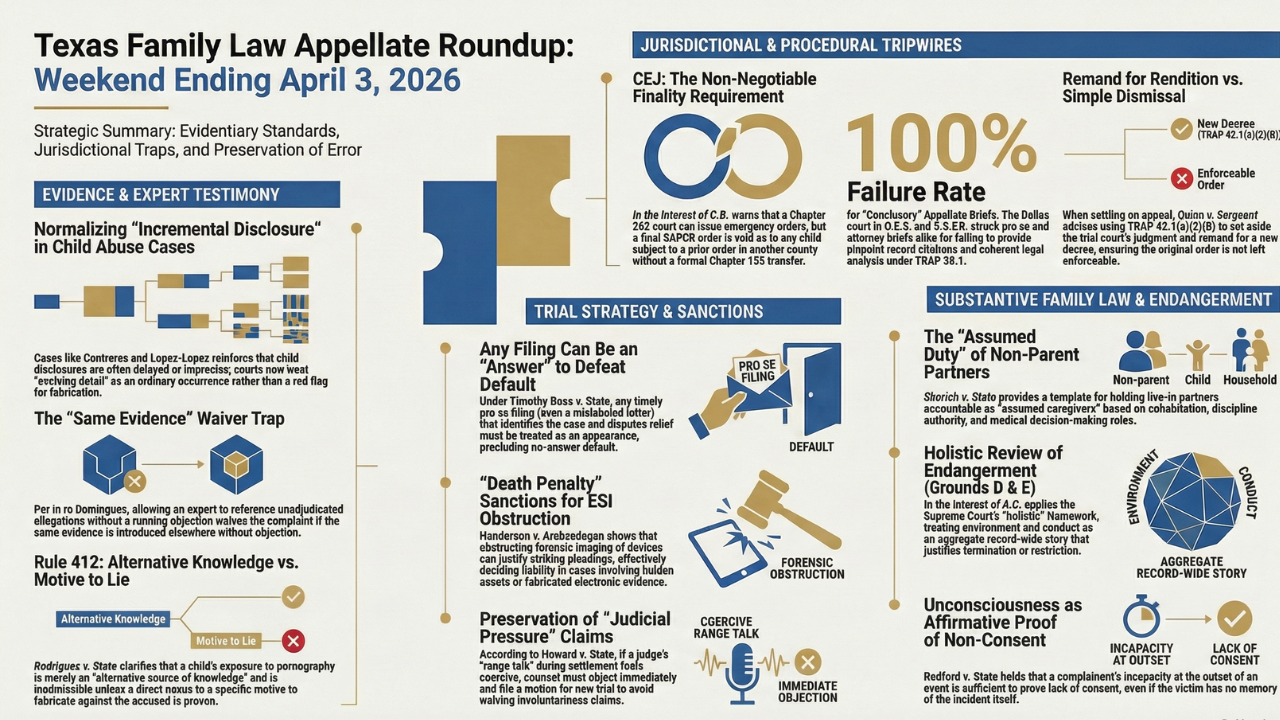
Texas Appellate Courts Issue Slew of Key Opinions for the Week Ending April 3, 2026
It has been a highly active week for Texas appellate courts, with sweeping decisions impacting everything from fatal discovery gamesmanship and trade secrets to strict jurisdictional boundaries in family law. Here is your definitive roundup of the appellate opinions for the week ending April 3, 2026.
Procedural Pitfalls & Discovery Sanctions
Texas appellate courts came down hard on procedural maneuvering and discovery disputes this week. In Mosser v. Flagstar Bank, the Dallas Court of Appeals reversed a summary judgment because the trial court improperly denied a continuance, ruling that a party cannot be forced to lose on summary judgment while being blocked from conducting basic, essential discovery.
Over in Austin, the Third Court of Appeals upheld “death-penalty” discovery sanctions—defaulting the defendants on liability—in Rickye Henderson v. Ali Arabzadegan. The court noted the defendants engaged in “flagrant and repeated” ESI discovery abuses, which included intentionally ignoring a tailored forensic imaging order designed to uncover fabricated text messages.
Meanwhile, the First Court of Appeals issued a stark warning to litigators seeking emergency injunctive relief in Dr. Robert Corwin v. Exxon Mobil Corporation. The court affirmed nearly $70,000 in Chapter 10 and Rule 13 sanctions against a law firm for seeking a groundless TRO designed solely for settlement leverage just days before a corporate merger vote. Notably, the court held that a voluntary nonsuit does not erase sanctions exposure, and non-signing attorneys can still be sanctioned if they directed and pursued the filings.
Family Law, Custody, & Jurisdiction
Family law saw several major jurisdictional and procedural rulings. The Sixth Court of Appeals dropped a jurisdictional bombshell in In the Interest of C.B., holding that Continuing Exclusive Jurisdiction (CEJ) is non-negotiable. The court vacated an agreed final order regarding one child because a Denton County court already held CEJ from a prior parentage order, reiterating that while a Chapter 262 court can issue emergency orders, it lacks subject-matter jurisdiction to render a final SAPCR order without a proper transfer.
In Bouknight v. Llanelly Enterprises, the First Court delivered a masterclass on jury charges, affirming a JNOV because the plaintiff’s charge only asked if a deed was “ineffective” rather than asking the ultimate, controlling question of “who owns the asset?”.
For DFPS cases, the Twelfth Court in In re L.C. dismissed a mandamus petition as moot after the children were returned to their parent and the underlying SAPCR was dismissed. The court ruled that harmful “aggravated circumstances” findings embedded in nonfinal temporary orders do not trigger the collateral-consequences exception to save appellate jurisdiction. Additionally, the Sixth Court affirmed parental terminations in In the Interest of A.C. and E.C., Jr., applying the Texas Supreme Court’s mandate that endangerment must be reviewed “holistically,” focusing on the cumulative aggregate weight of a parent’s unsafe conditions and course of conduct rather than isolated incidents.
In a unique criminal case with massive civil crossover implications, Skorich v. State; Woody v. State, the Seventh Court affirmed injury-to-a-child convictions and ruled that a mother’s live-in boyfriend assumed “care, custody, and control” of her child. The court found that his functional role in the family unit created a legal duty that supported omission-based criminal liability for severe dehydration and medical neglect during an interstate trucking trip.
Preservation and Appellate Rule Strictness
Strict adherence to appellate and trial rules was a running theme. In Norman v. Kahn Scheepvaart BV, the Fourteenth Court emphasized that jury-charge complaints live or die on strict preservation. The court affirmed a take-nothing negligence verdict because the plaintiff failed to lodge timely, specific objections and failed to ensure their requested charge was officially filed in the clerk’s record and ruled upon. A similarly strict approach to the record occurred in Maria Martinez v. Mario Antonio Perez Batres, where the Third Court abated a restricted appeal because the trial court had “released” original exhibits to the prevailing counsel rather than filing them with the clerk, leaving the appellate court with an empty evidentiary record.
Pro se litigants also felt the sting of waiver. The Fifth Court dismissed appeals in both In the Interest of S.S.F.R. and In the Interest of O.E.S. because the appellants’ briefs failed to comply with Texas Rule of Appellate Procedure 38.1. The court refused to speculate or hunt through the record for error, noting that pro se litigants are held to the exact same briefing standards as licensed attorneys.
However, pro se litigants scored a win in Timothy Ross v. The State of Texas, where the Fifth Court reversed a no-answer default judgment. The court ruled that a mislabeled, pro se “Motion to Void” functioned as an answer and appearance in substance, effectively closing the door on a no-answer default and entitling the defendant to be heard.
The TCPA and Trade Secrets
In Murray Lobb, PLLC v. Brandy Liss, the Fourteenth Court ruled that breach of fiduciary duty claims against a law firm are subject to early dismissal under the Texas Citizens Participation Act (TCPA) when the core of the complaint targets the firm’s litigation communications and court filings. The court noted that dismissal under the TCPA triggers mandatory fee-and-cost shifting.
In the trade secret arena, the First Court in Kassab v. Pohl held that a law firm’s client lists and fee contracts can qualify as trade secrets under TUTSA, even if accessed by a third-party marketing vendor, provided reasonable secrecy measures are enforced. However, the court reversed parts of the damages award, warning that plaintiffs must carefully tie their damages to TUTSA’s permitted frameworks without double-counting.
Criminal Rulings with Civil Crossover
In Erique Howard v. State, the Fourteenth Court rejected a claim of “judicial vindictiveness” after a judge pushed a 50-year post-verdict sentencing agreement. The court ruled that complaints of judicial coercion are waived if the defendant fails to object immediately or file a timely post-judgment motion.
In evidentiary rulings, the Fourteenth Court held in Johnny Ined Gonzalez v. State that a hearsay objection to a forensic interviewer’s testimony was rendered harmless because the exact same substantive evidence was admitted elsewhere without objection through the child’s own testimony.
Finally, in Oscar Antonio Rodriguez v. State, the Fourteenth Court upheld the exclusion of evidence that a child sexual abuse victim had previously viewed pornography on a relative’s phone. The court noted that under the rape-shield rule, porn exposure is merely an “alternative source of sexual knowledge” and does not qualify as “motive or bias” without a concrete, non-speculative link to fabrication against the accused.
Slides Deck
Share this content:



Post Comment
You must be logged in to post a comment.