


I downloaded Meta’s new Muse app today because I wanted to see whether it could do anything useful. I’ve spent years building software and experimenting with AI in a law practice, so I’m a reasonably demanding audience. But I also wanted to try it the way a regular person would: give it a job and see what happened.
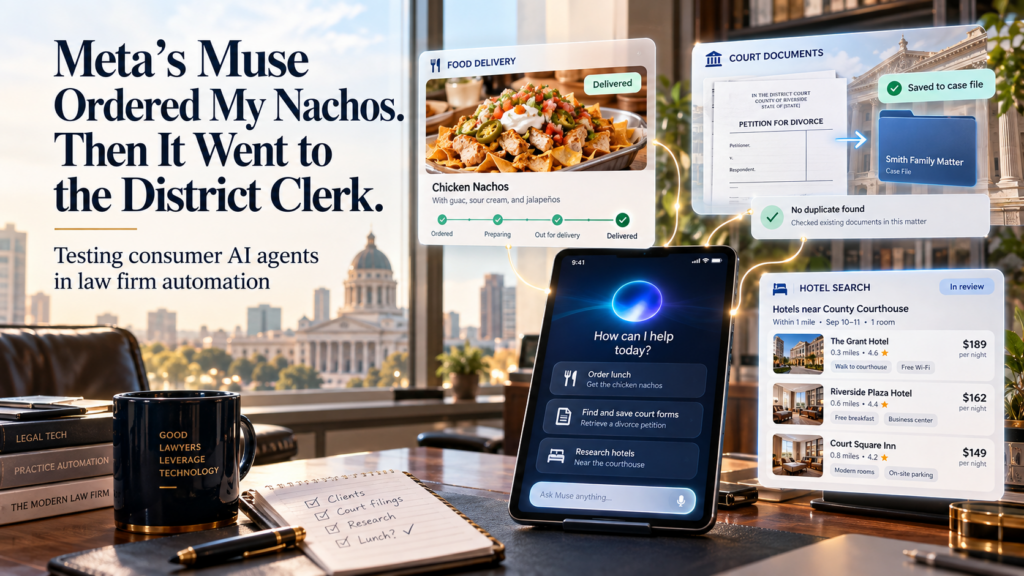
First job: “Order one large order of chicken nachos for delivery to [address].”
Muse chugged away. Next thing I knew, Uber showed up with nachos.
That got my attention, but ordering dinner is only so impressive. Plenty of apps will take my money and send me food. The interesting question was whether Muse could navigate a task that involved several websites and a little judgment.
So I gave it the Collin County district clerk’s website, my login information, and a cause number. I asked it to save the original petition for divorce to the corresponding Egnyte case file.
It did. It also noticed that we already had the document and told me so. And it got through the website’s CAPTCHA, which is more than I can say for my own patience on some days.
Finally, I asked it to find me a hotel near the district courthouse in Houston for tomorrow night, but to show me the options before booking. It did exactly that–I wanted research and a choice, not an unexpected hotel charge.
None of these tasks required a clever prompt. I described what I wanted in ordinary language. Muse moved between services, handled the intermediate steps, and came back with a result or a decision for me to make. That is the first AI experience I’ve had that feels ready for regular people who have no interest in learning how AI works.
For lawyers, the clerk’s website example is the one to think about. A surprisingly large part of legal work consists of finding the right thing, moving it to the right place, checking whether it is already there, and telling someone what happened. Those steps are small individually. Together, they consume a remarkable amount of time.
Of course, giving an agent access to a court account and a client file is a serious decision. I would not treat one successful retrieval as proof that it is ready for unrestricted access to a law firm’s systems. We need to understand what it can see, what it retains, how permissions work, and how to verify its work. The fact that it caught a duplicate was encouraging; it was not a substitute for supervision.
Then there is the broader privacy question. People have already handed over intimate details of their lives to social platforms in exchange for likes on family photos. My guess is that a lot of us will hand over even more in exchange for an assistant that actually gets things done. I’m not saying that is a wise trade. I’m saying the nachos arrived, the petition landed in the case file, and the hotel options appeared when I asked for them.
That makes the trade a lot harder to dismiss.
Share this content: