


Lead generation may start with social media advertising or organic content that directs prospective clients to the attorney’s web site. Turning that click into a client is a science. Here’s how you do it.
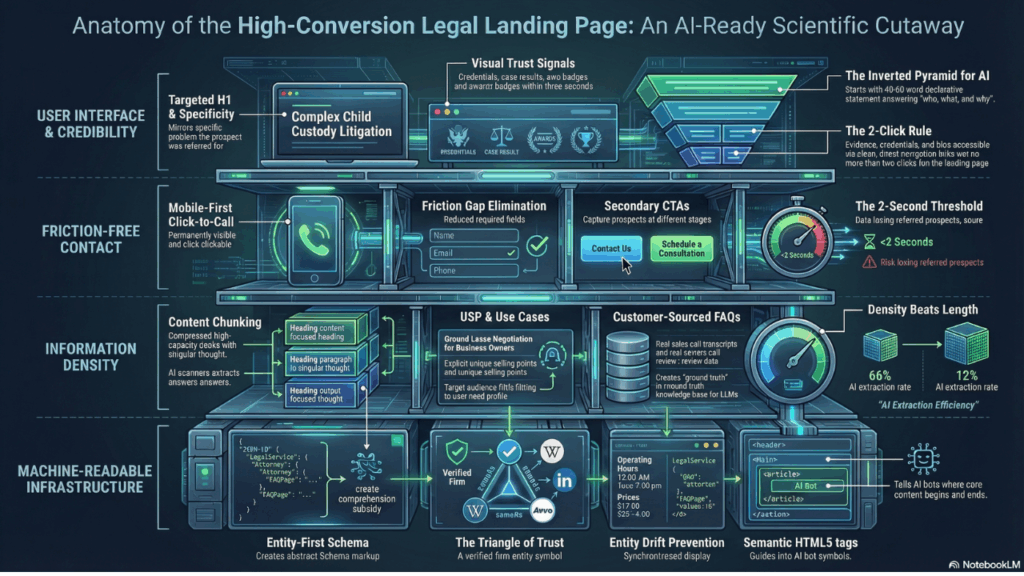
After reading what seemed like 1,000 articles on how to construct high-conversion landing pages and trekking through trial runs of about a dozen landing page products, I created an outline of what research and experience show to be the ideal landing page for a specific service offering or product.
1. The “Above the Fold” Experience (Immediate Trust & Frictionless Contact)
- Mobile-First Header: The page must load in under two seconds and feature a prominent click-to-call button in the mobile header that is completely visible without scrolling.
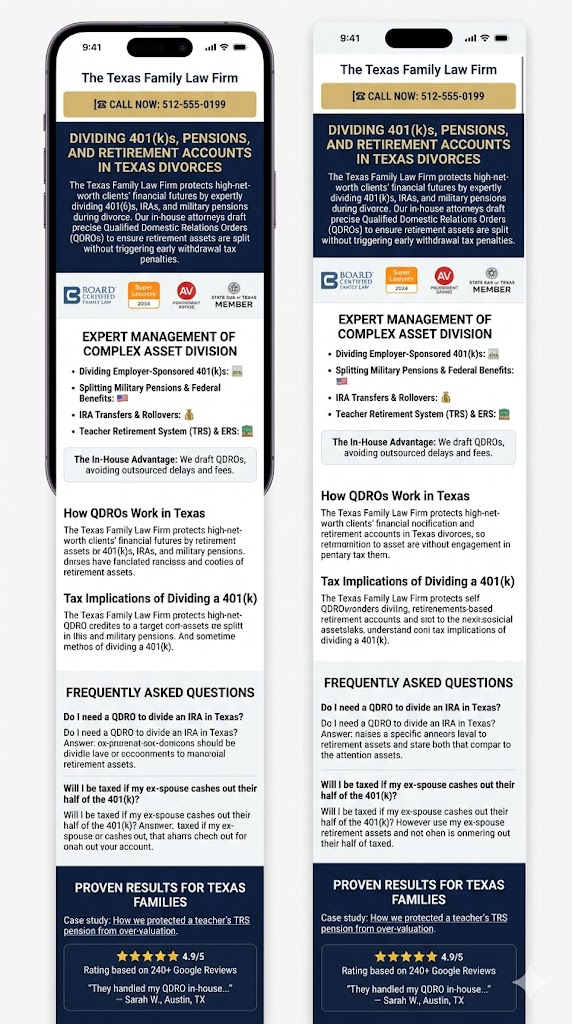
- Targeted H1 Heading: Instead of a generic heading like “Asset Division,” the H1 should explicitly mirror the prospect’s problem, such as “Dividing 401(k)s, Pensions, and Retirement Accounts in Texas Divorces”.
- The AI Inverted Pyramid (Citation Bait): The text immediately following the H1 should be a dense, 40-60 word declarative statement that answers the “who, what, why, or how” without any marketing fluff. For example: “The Texas Family Law Firm protects high-net-worth clients’ financial futures by expertly dividing 401(k)s, IRAs, and military pensions during divorce. Our in-house attorneys draft precise Qualified Domestic Relations Orders (QDROs) to ensure retirement assets are split without triggering early withdrawal tax penalties.”
- Visual Proof: Display credentials, board certifications in family law, or Super Lawyers badges immediately upon landing so the user does not have to scroll to validate your authority.
2. Specificity and Use Cases
- Explicit Scenarios: Detail 3 to 5 highly specific use cases or audience segments that this service addresses. For this page, you should have bulleted sections explicitly naming the types of accounts handled, such as:
- Dividing an employer-sponsored 401(k) using a QDRO.
- Splitting military pensions and federal retirement benefits.
- Transferring funds between IRAs without a QDRO.
- Clear Differentiators: State exactly why your firm is better equipped for this than a general practitioner, such as having attorneys who draft QDROs in-house rather than outsourcing them.
3. Machine-Readable “Chunking”
- Self-Contained Paragraphs: Organize the text into distinct, self-contained units of meaning under clear headings (H2s and H3s) like “How QDROs Work in Texas” or “Tax Implications of Dividing a 401(k)”.
- Structured Language: Ensure every sentence can survive in isolation. Do not use vague pronouns like “This process is complicated.” Instead, explicitly name the entities: “The process of drafting a Qualified Domestic Relations Order in Texas requires precise language to avoid IRS tax penalties”.
4. Authentic, First-Party FAQs
- Real Client Questions: Do not rely on generic keyword tools for your FAQs. Mine your firm’s intake call transcripts and customer service logs to find the exact questions people ask when terrified about losing their retirement.
- Examples: Answer specific questions like, “Do I need a QDRO to divide an IRA in Texas?” or “Will I be taxed if my ex-spouse cashes out their half of the 401(k)?”.
5. Proof and Internal Linking
- Link to Evidence: When a referred prospect wants proof of your relevant experience, they shouldn’t have to hunt for it. Use internal linking to guide visitors from this specific landing page to detailed case studies (e.g., “How we protected a teacher’s TRS pension”) within a maximum of two clicks.
- Review Counts: Display customer ratings and review counts prominently on the page to provide immediate social proof.
6. Technical and Architectural Foundations
- Nested Schema Markup: Implement deep JSON-LD structured data. Use
Organizationto define the firm,LegalServiceto define the location, and nest the specific retirement division services within anOfferCatalog. ApplyFAQPageschema to your question section. - Entity Alignment: Connect these entities using the
@idandsameAsproperties, explicitly linking the attorneys handling these retirement cases to their authoritative external profiles (like their Avvo rating, State Bar of Texas profile, or LinkedIn).
Example
Here is a rendition of what my landing page would look like following these pointers:

Tips, Tricks, and Tools
High-conversion landing pages are difficult to construct, even with the many landing page products that can help. Those products help with the layout, brand enforcement, and other mechanical details. But creating content that touches the imagination of human beings takes time, trial, and a willingness to change over time.
Follow these steps:
- Pick a landing page product that you like and that supports your brand’s identity;
- Go to Fiverr and find someone who will set up one landing page for you. Make it as nice friction-free as you can. Set a goal (purchases, phone calls, form completions) and a single product or service. Target that goal with respect to your selected product or service. Be aggressive in your targeting. No one likes lukewarm water. Make it hot for that one goal for that one product or service. I have a mantra that I chant to myself when working on landing pages and targeted content, “FMF” or “Focus My Friend.” 😉
- Create a short video about your product or service. Make it punchy. Look at all the content you see. The content that gets engagement has a low esthetic value. It’s dudes in their trucks, maybe with a shirt on, talking into a fuzzy lapel mic they hold in their hand. The great lighting, sharply focused video is automatically tagged as “commercial” and immediately swiped away. That’s great news!! Be raw, be yourself. Who you are, in nature, will repel some prospective buyers. Who cares? You’ll hate working for them anyway. But who you are will attract some great clients. Let them see who you are.
- PRODUCTION NOTE: Produce your video so that it is NOT appealing to people who will never convert. Make sure your video signals who should or should not click. If you’re selling coaching services, look like the most extreme version of that so couch potatoes know not to burn a click. If you’re selling high-end legal services, make it look like it will take some resources to hire you.
- Upload that video to your YouTube channel, promote the video with a goal of web site visits, and provide the URL of your landing page. Set a budget of $100 or $200 and see how many visits you get and how many of those visits convert to sales or leads.
Trial & Experimentation
This is quite unlikely to work right out of the gate. That’s OK. Change one variable at a time–change the video or change the landing page. If you are getting a lot of clicks, your video may be OK so start by tightening up the landing page. If you’re not getting clicks, it’s the video.
If you are getting a lot of clicks but not a lot of conversions, it’s either because your landing page is not inspiring the passions of your visitors OR your video is not filtering out people who will not be clients. For example, if your ideal client has complex issues that require high-end representation and you charge a consultation fee (you should always charge a consultation fee), your video needs to convey that this is not for everyone.
Your Video Should Signal Who Is and Who Is Not a Target Client
I’ve seen a few on-line advertisers who explicitly say something like, “If you make over $150,000 a year, this might be for you.” But those were always advertisements for personal fitness regimens that appeal to vanity anyway. That’s probably not the best way to filter clients who cannot afford your services. A better way that you can experiment with is using high-end content. By that I mean, if you are a lawyer, wear a tailored suit in the video and shoot it from a nice office or as you get in and out of your liveried vehicle. On the other hand, if your service is for veterans, signal that visually as well as with your words. Some retired members of the military are either not comfortable with “suits” or associate them with the civilian meddlers that made their lives unpleasant in the military–drop the tailored suits for those videos.
Be Who You Are
Authenticity sells. It just does. Of course if you reveal your true self, some people will not appreciate that and you will loose those clicks. GOOD! You didn’t want those clients anyway–don’t burn your click budget on people who aren’t going to mesh with you. There are good clients who will identify with your natural, in the wild, authentic self. Sell to them.
The overly polished video content is not worth the effort. Think about it: When you scroll into a high-def, well-lit, high-production reel, you almost immediately scroll away. That’s because the only people posting content like that are trying to sell to you. The esthetic of successful content is such that the prospective client actually listens to the words for a few seconds and resonates with what they hear. The visuals serve only to distract the eye and to assure the viewer that the person who, as it turns out, IS trying to sell to them, is a person they can identify with.
Conclusion
Successful social media campaigns require good video content backed up by landing pages that convert clicks to clients. It’s not easy to do, but you can do it. Just pick one service area, focus tightly on it, and give this a try.
Share this content: