


The “Impossible” Standard and the $30,000 Silence: 5 Shifting Realities in Texas Family Law
Practitioners often operate under the assumption that once a contract is signed or a procedural deadline is set, the outcome of a case is predictable. However, the legal landscape in Texas is far more fluid than it appears on the surface, shaped continuously by the interpretation of the appellate courts. This reality was underscored recently as Texas courts handed down 46 separate opinions in a single week, touching on everything from the nuances of expert witness testimony to the weight of an informal email in a divorce proceeding.
These rulings serve as a stark reminder that “settled law” is often subject to the shifting perspectives of the bench. Is a premarital agreement truly bulletproof? Is a procedural error enough to strip a party of their day in court? The latest updates suggest that while the rules are rigid, they are not meant to be weaponized to the point of creating an impossible standard for justice.
As we navigate these 46 opinions, five specific cases stand out as essential reading for any strategist. They highlight the “procedural gates” that can either protect a client’s rights or, if ignored, lead to an irreversible loss.
1. When “Impossible” Isn’t—The Expert Witness Lifeline
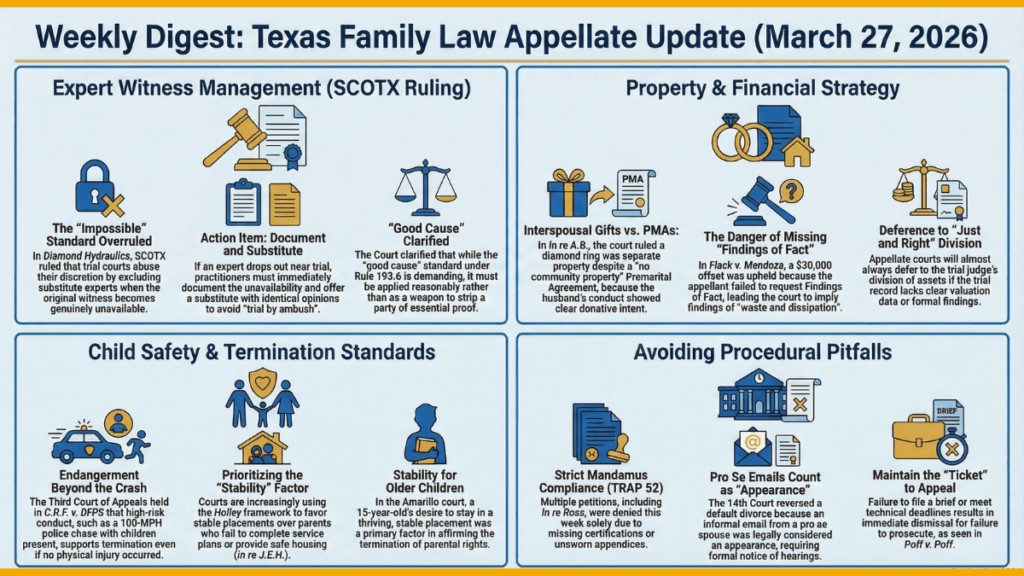
The Texas Supreme Court recently addressed the “good cause” standard for substituting experts in Diamond Hydraulics, Inc. v. GAC Equipment, LLC (this blog). While this was a commercial case, its implications for family law are massive, particularly when dealing with appraisers, mental health evaluators, and forensic accountants. In this instance, a designated expert moved out of state and refused to testify just as the trial approached. The trial court initially blocked a substitute, creating a scenario that mirrored “trial by ambush.”
The Supreme Court intervened to clarify the standard for “genuine unavailability.” The Court held that while the “good cause” standard required to substitute an expert under Rule 193.6 is demanding, it must not be interpreted as “impossible.” If your expert drops out near trial, you must act immediately to document the unavailability and offer a substitute with identical opinions.
The Court signaled that procedural rules should not be weaponized to strip a party of essential proof, emphasizing that the “good cause” standard must remain attainable when an expert becomes genuinely unavailable.
2. Actions Speak Louder Than Your Prenup (The Case of the Diamond Ring)
The case of In the Interest of A.B. serves as a cautionary tale for those relying solely on the written word of a Premarital Agreement (PMA). In this Dallas case, a marriage was governed by a strict “no community property” agreement. Despite this, a diamond ring was legally recognized as the Wife’s separate property through the concept of an interspousal gift.
The court looked beyond the contract to the conduct of the parties. The fact that the Wife wore the ring for years and had it cleaned without objection from the Husband was sufficient to prove “donative intent.” For the legal strategist, the synthesis is clear: conduct can constitute a waiver or modification of a written agreement in the eyes of a trial judge. Even the most carefully drafted legal contracts can be overridden by the daily behavior and choices of the spouses.
The Lesson: A Premarital Agreement is a living document. If you treat an asset in a manner inconsistent with the agreement—such as gifting jewelry and allowing its exclusive use without qualification—you may be legally redefining ownership regardless of what the initial contract states. (Blog Post)
3. The High Cost of Silence—Why You Must Request “Findings of Fact”
In Flack v. Mendoza, an El Paso case, the importance of procedural diligence was highlighted by a $30,000 loss. The trial court awarded the Husband the first $30,000 of home sale proceeds, a decision the Wife challenged on appeal. However, because the Wife failed to formally request “Findings of Fact,” her appeal was doomed from the start.
Without a formal request, the appellate court was forced to rely on “implied findings.” This meant the court assumed the trial judge found evidence of the Wife’s “waste and dissipation” of assets to justify the offset. Silence is consent to the court’s worst-case interpretation. If you do not force the judge to put their reasoning on paper, the appellate court will assume the trial judge had a valid, if unstated, reason for a “just and right” division. (Blog Post)
Trial Essentials for Property Appeals:
- Record Explicit Valuations for Offset Claims: Ensure the record contains specific testimony or exhibits for every dollar of a requested offset to prevent the court from guessing at the math.
- Request Findings of Fact: Always file a formal request to lock the judge into a specific legal and factual basis, thereby preventing the “implied findings” trap on appeal.
4. Endangerment Doesn’t Require a Crash
The standards for child safety and the termination of parental rights were clarified in C. R. F. v. DFPS. The case involved a mother who led police on a 100-MPH chase with three children in her vehicle. The court ruled that high-risk conduct alone is sufficient to support termination under the “endangerment” standard—even if no physical injury or crash occurred.
This ruling demonstrates a shift toward prioritizing the “stability” factor of the Holley best-interest framework over mere physical outcomes. The court determined that high-risk behavior, combined with a failure to complete court-ordered service plans and a lack of safe housing, created an environment of instability. In Texas, the potential for harm is just as significant as actual harm when the safety of a child is at stake. (Blog Post)
5. The Power of an Informal Email
A surprising procedural twist in Desta v. Wassihun highlights the court’s protection of the right to be heard. In this case, a pro se spouse sent a simple, informal email to the court regarding the proceedings. The 14th Court of Appeals ruled that this email constituted a legal “appearance.” Because the email counted as an appearance, the spouse was entitled to formal notice of the final hearing. When that notice wasn’t provided, the default divorce was reversed.
For the practitioner, this is a strategic warning: seeking a default judgment too aggressively when any form of communication exists from the opposing party is a high-risk move. If the plaintiff ignores an informal appearance to rush a default, they risk an expensive and successful appeal that sends the case back to square one.
“In Texas, the ‘ticket’ to your day in court may be as simple as an email, but the ‘price’ of admission is strict adherence to notice requirements.” (Blog Post)
Conclusion: The Proactive Practitioner’s Path
The recent wave of opinions in Texas family law makes one thing clear: compliance with procedural rules is not optional, yet the court still reserves a voice for equity. Whether it is a pro se litigant’s email or a high-stakes battle over expert witnesses, the “procedural gates” of Texas law are strictly guarded.
Success in this environment requires more than just a signed document; it requires constant diligence and an understanding that the court values both the letter of the law and the reality of the parties’ conduct. As you navigate your own legal matters, ask yourself: Are you relying too heavily on the perceived “iron-clad” nature of your documents, or are you paying enough attention to the procedural requirements that will ultimately determine your success?
Share this content: